
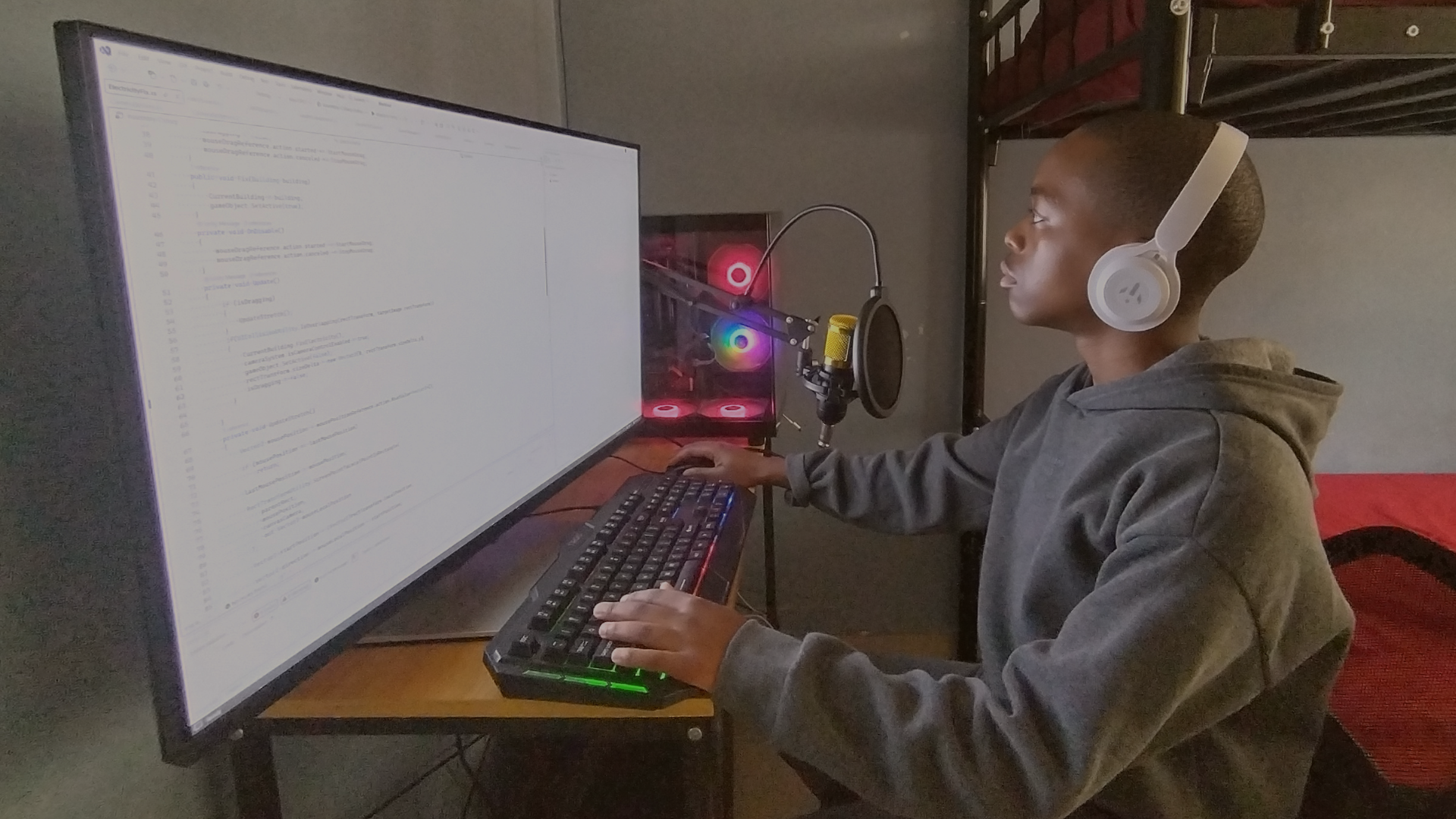
The X-Factored Youth was honoured to receive an email from a remarkable young game developer from Gauteng. Naturally, we were intrigued. What makes this young man different from his peers? What sparked his passion for game development, and what has kept him creating and growing along the way?
Lerato’s journey into game development began with a simple but powerful idea planted by his father: don’t just consume games — create them.
That encouragement became the starting point of a journey that has continued to grow year after year. What began as curiosity has developed into a genuine passion for game development, creativity and innovation.
We are proud to introduce you to this truly X-Factored young man — Lerato!
We asked him a plethora of questions to give you a glimpse into his world: his journey, his inspiration, the challenges he has faced, his experiences as a young South African game developer, and his vision for the future.
So, let’s get to know Lerato — a young creator who is not simply playing the game, but building his own.

You’re only 17, but you’ve been making games for 9 years. What made 8-year-old Lerato think, “I want to make games” instead of just playing them?
As a kid I played a lot of computer games, which forced me to become more and more familiar with the interface of a computer. So much so that I learned to read and type at a very early age because a lot of these games had text that I had to read in order to play
the game. Now pair this with the entertainment value of playing a game and you’ve got yourself a steady foundation for a game dev passion I distinctly remember myself and my father playing an old game, and while it was my father’s turn to play, a seed of curiosity was planted in my brain, and this seed kept growing as time went on. I started by looking up “how to make a game”, the term Game
Development wasn’t even in my vocabulary. Once I found a few youtube videos about game development everything changed. My sessions with my dad went from just gaming to me dissecting the different pieces that made the game.

Your dad taught you to “produce more than you consume.” How much has that
mindset influenced the person and developer you are today?
Because of this phrase, I’m quite meticulous when it comes to what I consume and how much I consume. As a result I’m a productive person.
What was the first game you ever made—and how terrible was it?
I could never forget my first released game. I was enrolled into a Game Jam(a short, time-limited event where individuals or teams build a video game or board game from scratch) where I had to create a game around a theme. I remember feeling incredibly pressured since I couldn’t create games that quick yet. Looking back, the game is nothing to write home about but it really taught me how to handle pressure so I appreciate the game for what it is and have no regrets(yes, I still have access to the game).
You went from Scratch to Unity at just 8 years old. What did you actually know about game development back then?
Because of my experience with Scratch, I had a lot of problem solving skills which is a big part of game development. That being said, the jump from Scratch to Unity is large to say the very least. Surprisingly I wasn’t overwhelmed for long and didn’t get demotivated.
You’ve made hundreds of projects. What’s one project you created that nobody knows about but you’re still proud of?
This is another game jam project that didn’t get to see the light of day. It’s a game about building a Rube Goldberg machine of sorts. The only reason why I didn’t finish it was game design and time constraints, but even with the little it had it was a fun game.
What does making a game at 17 in South Africa look like? Are you sitting in your room coding at 2 a.m., or is there more structure to your process?
It’s definitely the former. Most of the time I’m crunching, working on a game at 4am or trying to figure out why something is broken and dreaming of a solution. It’s really a labor of love, most of the time I’m stressed but the reward is always worth it. There’s rarely a
structure when I’m making a game, I rely on self-discipline more than anything else. The South African Angle.
There are millions of young people in South Africa who love gaming. Why do you think we don’t see more South African-made games breaking through internationally?
I think the game development industry in South Africa is very small compared to the rest of the industries in this country. Many gamers play games from other countries because that’s what is available. However, there are South African games that have made it big internationally, most notably ‘BroForce’ – by Free Lives, an indie game dev studio based in Cape Town.
Do you think South African game developers are creating games that actually represent young South Africans—or are we mostly copying what we see overseas?
I wouldn’t know since I haven’t seen or played many South African games. From the few I’ve played (BroForce), they are incredibly unique and engaging.
If you had unlimited resources to create a game specifically for South African Gen Alpha, what would that game look like?
A game for gen alpha, to me, would be something like “Mzanzi Street Soccer”. It’s familiar enough to gen alpha and genz for them to instantly “get it”. I wouldn’t want this to just be another “FIFA” game, I’d make this capture the feel of South African street football, the rules, the flexibility and everything that gives it its DNA.
What South African things would you love to sneak into one of your games—slang, locations, music, characters, culture, humour?
I’d say the locations, and humor. I’m fairly in touch with these parts as well as South African culture so it would be easy for me to sneak these into any game while staying true to the purpose of said game.
Do you think a game made by a 17-year-old South African can compete globally with games made by massive international studios? Why?
Yes, and I’m fairly confident. In this day and age anyone with a great idea and execution can out do large game dev studios. Take for instance ‘Schedule 1’, an indie game by Tyler – who spent 3 years making the game alone. The game has sold over 8.8 million copies world wide beating out some of the biggest games of that time. With the right idea, execution and marketing, I also have a chance to capture gamer’s hearts in that way. Rogun Army
Where did the idea for Rogun Army really come from? Was there a specific moment when you thought, “I need to make this game”?
Before I decided to create Rogun Army, I spoke to so many people who loved the idea of this game existing because they’d like to see the old days where games were about having fun and bringing people together. Even besides Rogun Army, you’ll see on social
media what they call “Nostalgia bait” which is content that reminisces on the quote on quote “good old days” . The fact that this content gets so much engagement tells me that there’s an audience that wants to bring back what we lost. A year ago, I had a call with my friend that went on for hours just talking about how they’d love to play this game with their friends and how this game could help the younger generation grow up creating social connections in real life instead of just consuming content all day. After this call I
realized just how great of a game Rogun Army could eventually become.
You’re basically trying to bring back the feeling of playing games together in the same room. Why do you think that experience has become so rare?
I’d credit this to today’s digital landscape, we have so many products fighting for our attention, implementing algorithms to keep us glued to our screens because it makes them a profit. Now more than ever people consume more than they produce, and it’s generally harder to go outside and interact with others when everything you need is in your pockets.
You say you want Rogun Army to make people stop scrolling and interact with each other. Is your game actually about gaming—or is it secretly about getting people to socialise?
Rogun Army is both. I want my players to have fun WHILE socializing, which is the power of gaming. It can bring change through entertainment.
What makes Rogun Army different from the thousands of other mobile games people can download today?
The “x factor” of Rogun Army is its message and the awareness it’s trying to bring. Yes, the game is fun and that might set it apart, but the reason I’d recommend it over any other game is what the game is trying to achieve.
You designed it for LAN/offline couch play and more than 16 players. What happens when 16 people are all playing in the same room?
Before Rogun Army was released to the public, it had to go through a closed testing phase(which is a requirement set by Google). During this phase you have to gather 12 or more people to test the game over a period of 2 weeks. I found a bunch of my friends to help with this endeavour, and what was once just a requirement for google play, turned into a confirmation to me that Rogun Army is a game worth working on. On our first day testing I had maybe 3 to 4 people in my room playing the game. It had bugs and shortcomings, but even then, the game filled the room with joy. I found myself feeling connected with the people I was playing the game with. So, I decided to host a few more days of playtesting. More people came to try out the game and it was the first time I saw a glimpse of what social connections used to be, that’s when I knew for sure I was on the right path. 3 months ago, a day before the official release day for Rogun Army I hosted a release party with all the people that had helped me test this game, at this point the game had matured and was filled with new toys to play with. That release day was an insurmountable amount of fun and excitement. It definitely deepened bonds and made me realize that this game could have a real world impact.
What’s the most chaotic or funniest moment you’ve seen while people were testing Rogun Army?
There are tons of moments to recall, most notably, while I was playing with my friends I remember one of them discovering the Rocket Launcher and absolutely destroying the rest of us. It was so hilarious because we really couldn’t do anything about it. That was until his rocket launcher ran out of ammo, we made sure our friend had a taste of their own medicine. This is one of many funny moments that came through playing Rogun Army.
If Rogun Army suddenly went viral tomorrow, what would you want people to understand about the game beyond “it’s a cool game”?
I want people to know that this game is meant to connect them with each other. If it was up to me I wouldn’t even add single player functionality to this game – but since that’s required to keep player retention high, I added it. Point being, this game should be a reason you stop mindlessly scrolling and start interacting with the person next to you.
What feature do you desperately want to add to Rogun Army but haven’t been able to yet?
I actually wanted to add physics based destruction into the game, where every wall is now merely a suggestion. But since I don’t have the resources to create that and optimize it, I’ve put it in my future “wish to-do list”.
If you could put Rogun Army into the hands of one famous gamer or creator, who would you choose and why?
It wouldn’t be one creator. I’d select a content creator group that plays games such as VanossGaming. A group of creators playing the game would do it more justice than just one person playing alone or against bots. The Mind of a Young Developer
What is harder: coming up with a great game idea or actually finishing the game?
This is a tough question, but I’d say actually finishing the game. Great execution is much harder to pull off than just coming up with an idea. I’ve had dozens of ideas that sound good on paper but don’t translate into a full game.
You’ve described yourself as “overly ambitious.” When does ambition push you forward, and when does it become a problem?
My ambition is great when it lets me push the barriers of what is thought to be possible or creating something I’ve never seen done before. The problem with this ambition is that more often than not I find myself working on a project that I don’t have the resources
or knowledge for, leading to a great burnout.
How do you deal with spending months making something and then realising… “Yeah, this isn’t actually very good”?
I actually don’t mind when this happens because I’m usually working on a few projects at any given time. For instance, while making Rogun Army I’ve been working on a game called HalfBloom for just as long if not longer. So if a game flopped, I wouldn’t be so worried as I have a plan B. Side note, bouncing on different projects like this keeps me from burning out. When I’m tired of one game I get more work done on the other. However, I do this cautiously because having more than 2 projects can be counter-productive and lead to even more burnout.
What’s something about game development that you thought would be easy but turned out to be ridiculously difficult?
Game design. I thought programming, making art and music would be my toughest challenge when making games, and while those things are indeed difficult, they don’t come close to game design. Designing a game requires a good intuition/feel for fun game play, you need to step into the shoes of a player and decide how they should feel at any given moment in the game. This is easier said than done.
Do you consider yourself more of a programmer, designer, entrepreneur or storyteller?
I am a programmer. I just love programming and the problem solving that comes with it(even if it’s 90% banging your head against the wall). If I wasn’t making games I think I’d still be doing something that requires programming.
What’s one thing you’ve learned from making games that has nothing to do with computers?
The importance of discipline over motivation. Making a game takes a long time, and a lot of effort. Motivation is temporary and most likely won’t last the whole game development cycle. This is where discipline comes in, discipline doesn’t care if you’re demotivated today or motivated tomorrow, you still clock in and put in the work. This now carries on to every other part of my life, I don’t rely on motivation to sustain myself through long endeavours. Instead, I put in the effort to do a little bit everyday. The Future
You’re interested in eventually becoming an indie developer, but you also want to work at an established studio first. Why?
Being an indie developer is very risky. You spend years, maybe even a decade working on a game only to find out no one cares about it or it isn’t as fun as you thought it would be. Not only have you wasted a lot of time but you also have no income to show for it. And even if you do release a good game, it’s rare that your game earns enough to financially sustain you for a long period of time. So having a job while also working on your own studio is the safest and most financially responsible way to start an indie game development studio.
If a major game studio offered you your dream job tomorrow, what would you want to be working on?
I’d want to be the one programming game mechanics for their game, and creating tools for the other developers to use in the pipeline.
Where do you see yourself at 25? Still building Rogun Army, running a studio, working for a major developer—or something completely unexpected?
Still making games. Except bigger, and better. I’d also like to explore other fields in science as that was also an interest of mine as a kid.
If you could give your 8-year-old self one piece of advice before he opened Scratch for the first time, what would you tell him?
To be honest he did everything right. I’d encourage him to go even bigger with his projects, to shoot for the stars, aim for the moon. It might seem scary at first, but that type of ambition pays off in the end. And I’d finish with these…
What’s the biggest misconception people have about young people trying to build something serious?
They think that it’s a “phase” – a 2 week dream. I think people should encourage young people whenever they try to build something serious, even if it is just a 2 week phase, it shouldn’t be looked down upon because it’s greater than most alternatives. Young people are future leaders in many industries and learning to build now will allow them to have experience later on.
A lot of young people have ideas but never actually build them. What’s different about you?
Discipline and extensive evaluation. I start off by imagining the end product of whatever I want to build. Then, I imagine the journey, the ups and downs that come with building my idea. What helps a lot is researching how other people tackle something similar and
what it looks like when they do so. Once all of that is done, discipline comes in. I put my mind to that project and see it through to the end.

If someone watching this is 15, 16 or 17 and has an idea for a game, app or business but thinks they’re “too young” to start—what would you tell them?
In the modern world there’s almost nothing a young person can’t create, especially digitally. Gone are the days where you need a formal education or a certificate to build something. All the resources you need are available on the internet, you just need self-discipline. For instance, all my game dev knowledge is self taught through the internet. No school, just me and youtube.
And finally: Lerato, you’re 17. You’ve already been developing games for half your life. What’s next?
More games, I don’t plan on stopping anytime soon. There are so many people I want to inspire and touch with my games. I think games are a great and an underrated medium of communication past entertainment. That is, if they are done right.
More Videos

Leave a Reply